When we started working on this blog, we wanted to create a place where we could keep ourselves accountable; and hopefully provide encouragement for those of you who read our stories that the future is not as grim as it may appear at times. Coming to the realization that we had to start taking responsibility for our finances took some time, and we have had to constantly reaffirm our commitment to our goals and our future. As we move closer to our being received into the Orthodox Church, I thought it would be appropriate for some financial confession.
If I'm being honest with myself, I financed my way through college and graduate school by reasoning that ten years (the estimated time to repay student loans from the time you graduate) really isn't that long, and I'd have a job that paid well enough to cut that time in half. When I received my bill for $28,000 from Gordon College, I was just thankful that it wasn't six figures like others of my graduating class. Of course, I didn't take into account that my first job out of college would pay me $7.50/hr, nor that I would jump right into graduate school-- taking on another $25,000 in student loan debt. I also had to fix my car ($3000) and buy a new one. (Yes, I bought a new car.) $14,000 later and I was $67,000 in the hole. Then we got married (bringing another $15,000 into the mix), got a well-paying job, and proceeded to blow our money like children! By the time we realized that we were in trouble, the damage had been done: we were in deep debt and struggling to pay our monthly bills.
Looking back on it now, a lot of this could have been avoided if we had been a little more discerning in our choices. For one thing, I definitely wouldn't have hit "accept" on the loan with a 10% interest rate. I probably also would have bought a nice used car with the money I got from selling the old one. Now we're stuck paying for our mistakes, and missing out on a lot of the fun things in life now because we've made a decision to change our family tree and give our family a brighter future.
Travelling the road from debt to the ultimate family vacation.
Wednesday, August 10, 2011
Saturday, August 6, 2011
How to Budget : Step 2
These are the steps we take to do our budget, here we'll deal with Step 2.
- Determine income and pay periods for the month
- Name your Income
- Make it balance
- Allocate your expenses for each week
- Prioritize Irregular Income
Step 2: Name Your Income
Now that you have your total income in front of you, you'll need to determine where to send it. We recommend prioritizing your naming so that you have the basics covered. On a calculator, or a piece of scrap paper if you're arithmetic savvy, subtract each item from your total as you go. This will help you see how far your paycheck can go.
If you run out of money before getting to the end of the list, don't worry, go ahead and finish. We'll deal with the overage in Step 3 and Step 5.
- Charitable giving - we do 10% of total income - whether to a church or a non-profit, giving a portion of your money away not only gives you a warm fuzzy feeling and makes you a better person, but it also will help you relax if money is a point of stress
- Savings: If your savings account/emergency fund is below $1000, try to raise it. (If you can't fill it completely and cover #3, do as much as you can.)
- Four Walls: House, Food, Transportation, Clothing - this includes mortgage/rent, utilities, diapers, fresh veggies, car payment, gas, oil changes, new underwear, all insurance premiums and anything else that you need to function. This does not include: brie, beer, spinners, another purse or that cute baby dress.
- Incidental expenses - includes such things as date night, trip to see grandparents, birthday gifts, a hair cut, and other things which help keep you sane, but are not truly necessary for survival. Remember, getting out of debt is about cutting life style. This is where your lifestyle will be cut.
- Outstanding debt - Make sure to pay the minimum on everything first, then add any remaining income to the debt with the smallest total balance. Try to pay it off completely. When you do, you can add that minimum payment to the minimum of the next smallest debt which will help you pay that one off faster. This is the principal behind the Debt Snowball. Don't worry about which debt has the highest interest rate, just pay things off as fast as possible so you can tell your money where to go instead of wondering where it went.
When we got to the end of this step the first few times we did our budget, it felt like we got a raise. It's amazing how much even a little bit of money can do, when you know what it's doing and why.
We'll cover Step 3 in our next post, in which we'll determine who does get paid and who does not.
Wednesday, August 3, 2011
Guest Post on Relishments.com
We recently had the opportunity to write about eating on a tight budget for Emily's dear friend Emily. (It's weirder than you think, our last names were really similar and we were college roommates.) But anyway, check out our guest post on relishments.com.
Please note, she's been at this blogging thing for a lot longer than we have, so her page is really nice.
How to Budget : Step 1
We began posting the last time about the process of writing our monthly budget. One of the principles we work with through our Total Money Makeover is a written budget at the beginning of every month. Like Dave says, "Every dollar has a name": which means that every penny for the month gets spent on paper before the month begins. It's not always easy, but it's incredibly rewarding; and we usually discover we have more money than we thought. When budget night comes, Caleb uses the Gazelle Budget Software on the Total Money Makeover website and Emily uses Dave's budget forms (found here).
Below are the steps we take to do our budget: (We'll deal with the first step in this post)
- Determine income and pay periods for the month
- Name your Income
- Make it balance
- Allocate your expenses for each week
- Prioritize Irregular Income
Supplies:
Step 1: Determine Income and Pay Periods for the Whole Month
- previous month's paychecks and/or projected income statement
- previous month's budget form (if it exists)
- calculator
- Budget forms or legal pad
- pencil with a good eraser
- Computer (if using online software)
Before you can spend your hard earned cash on paper before the month begins, you have to know how much money is available to you. (For those of you with an irregular income, there's a form for that that we will discuss later.) You also need to know when you will be paid so that you can decide what bills and expenses are covered during which week in the month. Emily does the allocated spending sheet at the end of our time crunching the numbers.
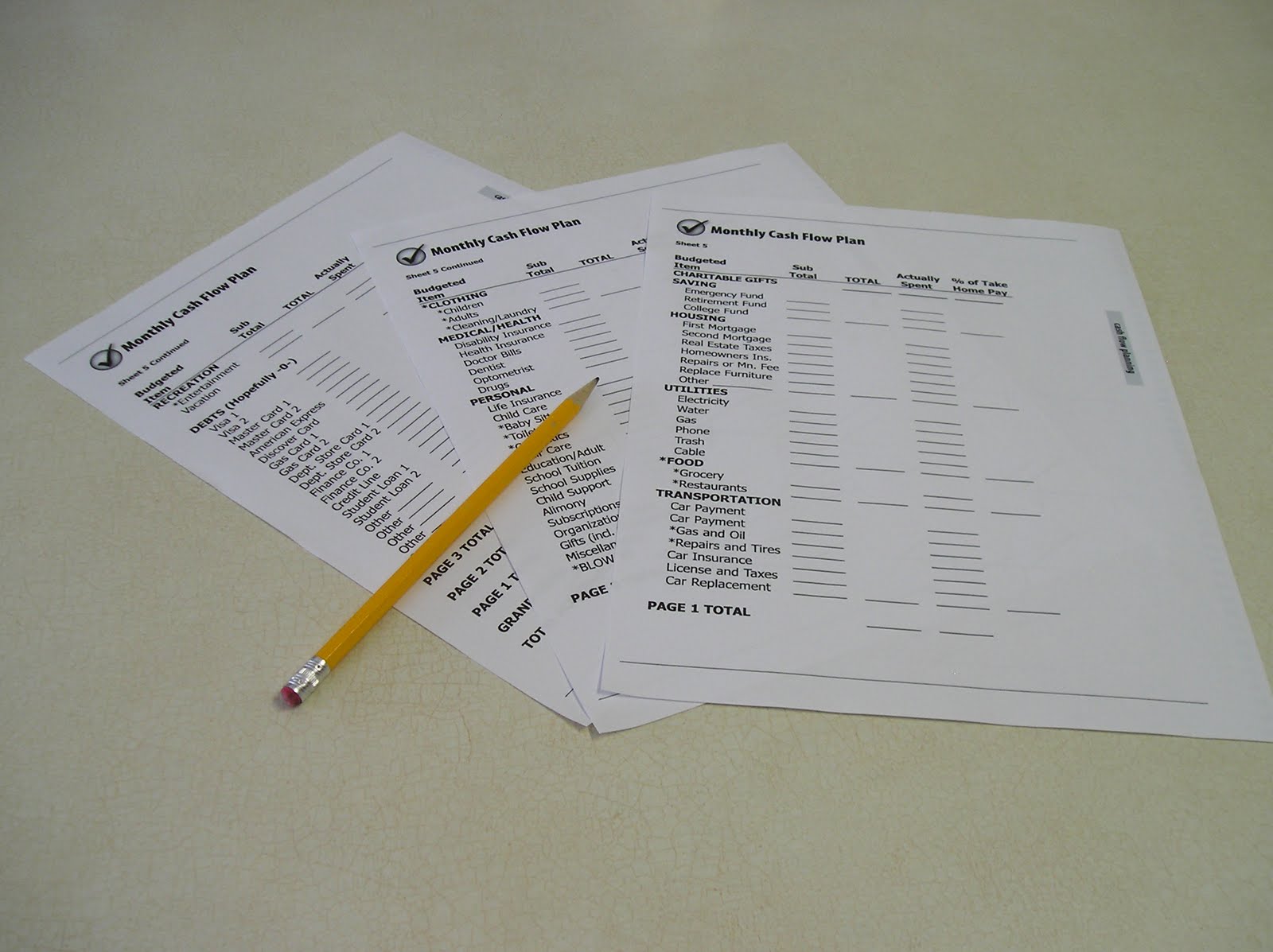
We find it easiest to add up the various sources of income and write down the source at the bottom of page 3 of the Dave Ramsey form, but if you're starting from scratch, write it on the first line.
This month, our income looked like this:
School Pay Check 1 + Summer Job Pay Check 1 + School Pay Check 2 + Summer Job Pay Check 2 = Total Income
Our paychecks are currently bimonthly, but they don't come at the same time (i.e. the school pays on every other Friday, the summer job on every other Monday) -- we'll deal with that conundrum in Step 4.
Don't include any income that you aren't actually sure you will be getting. If you work on commission, tips or hourly, budget what you can reasonably expect to receive, not what you hope you'll earn. For example if you always work at least 20 hours a week, but can work as many as 40, budget the 20 in this step. Following this method will help you prioritize your income and especially important if you don't have very much of it.
We'll deal with irregular income in Step 5.
Tips: Make sure you know when you can expect your pay check to be available to you, this may be different from the day you actually get paid if you have direct deposit.
Also, determine whether or not you get paid on specific days of the month, or days of the week. Is it every other Friday or the first and third Fridays? The first Wednesday of the month or the 1st of the month?
Next, we'll go through Step 2, in which ever dollar gets a name and life gets prioritized.
Thursday, July 28, 2011
Budgeting Again
Here we are at the end of another month. July seemed really long this year, especially since we had our Emergency at the end of June which spilled into July. At the lowest point, our Emergency Fund had $1.14 and our checking account had $48. We usually have more of a cushion, but there was an issue with payroll that has since been cleared up.
Let me tell you, being that broke I was so grateful for our budget. I looked at the bank account (gasped and swore a bit) and looked at my check book. Within five minutes, I knew we were ok. All our checks had cleared, and there was nothing hanging out there on the debit card waiting to clear because we use cash for all our incidental purchases (groceries, gas, clothing, etc.). Even though we had less than I would have liked, I knew none of it would go anywhere before we got paid again. I knew that every one of those dollars was named "sinking fund for Caleb's life insurance", which we pay at the end of the year, and would not be leaving the account.
That was our situation when we did our July budget. Now, it's time to do August. We have refilled our emergency fund and Caleb's life insurance fund. Our car now has a rebuilt transmission and a new muffler. We're free and clear to look forward to next month and all it's oncoming craziness.
Usually, we'd just adjust last month, but since August will be so completely different than previous months, we'll be starting from scratch and we'll go through it with you.
There are two forms that we use from Dave Ramsey's My Total Money Makeover site (they're in all of his books too). The first is the Cash Flow Plan (pdf) and the second is the Allocated Spending Form (pdf). Over the next few days we'll walk through how we do our budget so you can see how these forms work in real life.
It'll be way fun. You're welcome.
Let me tell you, being that broke I was so grateful for our budget. I looked at the bank account (gasped and swore a bit) and looked at my check book. Within five minutes, I knew we were ok. All our checks had cleared, and there was nothing hanging out there on the debit card waiting to clear because we use cash for all our incidental purchases (groceries, gas, clothing, etc.). Even though we had less than I would have liked, I knew none of it would go anywhere before we got paid again. I knew that every one of those dollars was named "sinking fund for Caleb's life insurance", which we pay at the end of the year, and would not be leaving the account.
That was our situation when we did our July budget. Now, it's time to do August. We have refilled our emergency fund and Caleb's life insurance fund. Our car now has a rebuilt transmission and a new muffler. We're free and clear to look forward to next month and all it's oncoming craziness.
Usually, we'd just adjust last month, but since August will be so completely different than previous months, we'll be starting from scratch and we'll go through it with you.
There are two forms that we use from Dave Ramsey's My Total Money Makeover site (they're in all of his books too). The first is the Cash Flow Plan (pdf) and the second is the Allocated Spending Form (pdf). Over the next few days we'll walk through how we do our budget so you can see how these forms work in real life.
It'll be way fun. You're welcome.
Sunday, July 24, 2011
Slogging
There's not to much to report as far as our debt paying-off progress or road trip plans. We continue to battle the temptation to do something off budget "just this once" "because we deserve it".
At some point, I think, it gets easier. But we aren't there yet. Right now, we have to stay focused and do what's needed to get it done in the long run. Every day. Little by little. Baby steps.
Sunday, July 3, 2011
Sometimes, paying off debt really stinks.
Have you ever prayed for patience? Whenever I do, it seems virtually guarenteed that within mere hours something will come along and test my patience to the limit, usually leaving me furious, frustrated and all together impatient.
The same thing seems to happen whenever I make a resolution of any kind, including getting serious about getting out of debt. Not too long ago, I blogged about our Emergency Fund and how we've used it a few times, but it generally seems to cover things.
"Things" in this case does not include a rebuilt transmission, as we discovered last week. No, a transmission generally runs about twice our emergency fund ($1897, to be exact). So, what to do? We were able to squeeze about $100 extra out of our budget for the month, but that still left us about $800 in the hole. To make up the difference, Caleb's dad stepped in and provided. In our July budget, we will be paying him back as soon as our four walls (housing, food, transportation and clothing) are covered. Then, we'll be rebuilding our emergency fund. Even with Caleb working an extra job and nearly doubling our normal income, we won't be able to go back to our snowball until August, unless money drops from the sky.
Financially, I know we'll be fine. Emotionally, I'm pissed off, frustrated, tired and, in moments of weakness, ready to throw in the towel and just be defeatest about the whole thing. It seems like every time we're ready to really get going with paying down the debt some little thing pops up and wont let us do it quite yet. When will it end? When does it get easier?
Well, not yet.
The good news is that we are not going through this alone. God always knows when we're at our most exhausted (physically, emotionally, financially, etc.) and uses that exact moment to remind us of his love and provision. In that vein, two things happened this week. The first was a talk that Dave Ramsey gave at my uncle's church. He sent me the link to the videos. In that video Dave talks about how when the transmission blows (and he uses that example) is a test. This is when the rubber meets the road. If we weren't really committed to being debt free, it would have been really really easy to open a new credit card account to pay for it.
The second moment was at church this week. The gospel reading was, of course, Matthew 6:19-34. Do not be anxious. I know what you need. I'll take care of you. Keep doing what you're supposed to do and let me handle tomorrow.
Well, not yet.
The good news is that we are not going through this alone. God always knows when we're at our most exhausted (physically, emotionally, financially, etc.) and uses that exact moment to remind us of his love and provision. In that vein, two things happened this week. The first was a talk that Dave Ramsey gave at my uncle's church. He sent me the link to the videos. In that video Dave talks about how when the transmission blows (and he uses that example) is a test. This is when the rubber meets the road. If we weren't really committed to being debt free, it would have been really really easy to open a new credit card account to pay for it.
The second moment was at church this week. The gospel reading was, of course, Matthew 6:19-34. Do not be anxious. I know what you need. I'll take care of you. Keep doing what you're supposed to do and let me handle tomorrow.
Subscribe to:
Posts (Atom)