Showing posts with label How to Budget. Show all posts

Saturday, September 3, 2011

How to Budget: Step 3


At long last, Step 3 of our 5.  Believe me, it is much easier to do these steps than to write about them.  Probably even easier to do them than to read about them. 
  1. Determine income and pay periods for the month
  2. Name your Income
  3. Make it balance
  4. Allocate your expenses for each week
  5. Prioritize Irregular Income


Ah, math.  If you don't already have a nice sharp pencil and good eraser handy, grab one.  You'll need it.  (A blackboard would work too, of course.)  A calculator might be helpful too, if your arithmetic is rusty.  I promise that there will be no algebra or calculus in this step.  All we need to do is add up all the expenses and make it equal the total income.

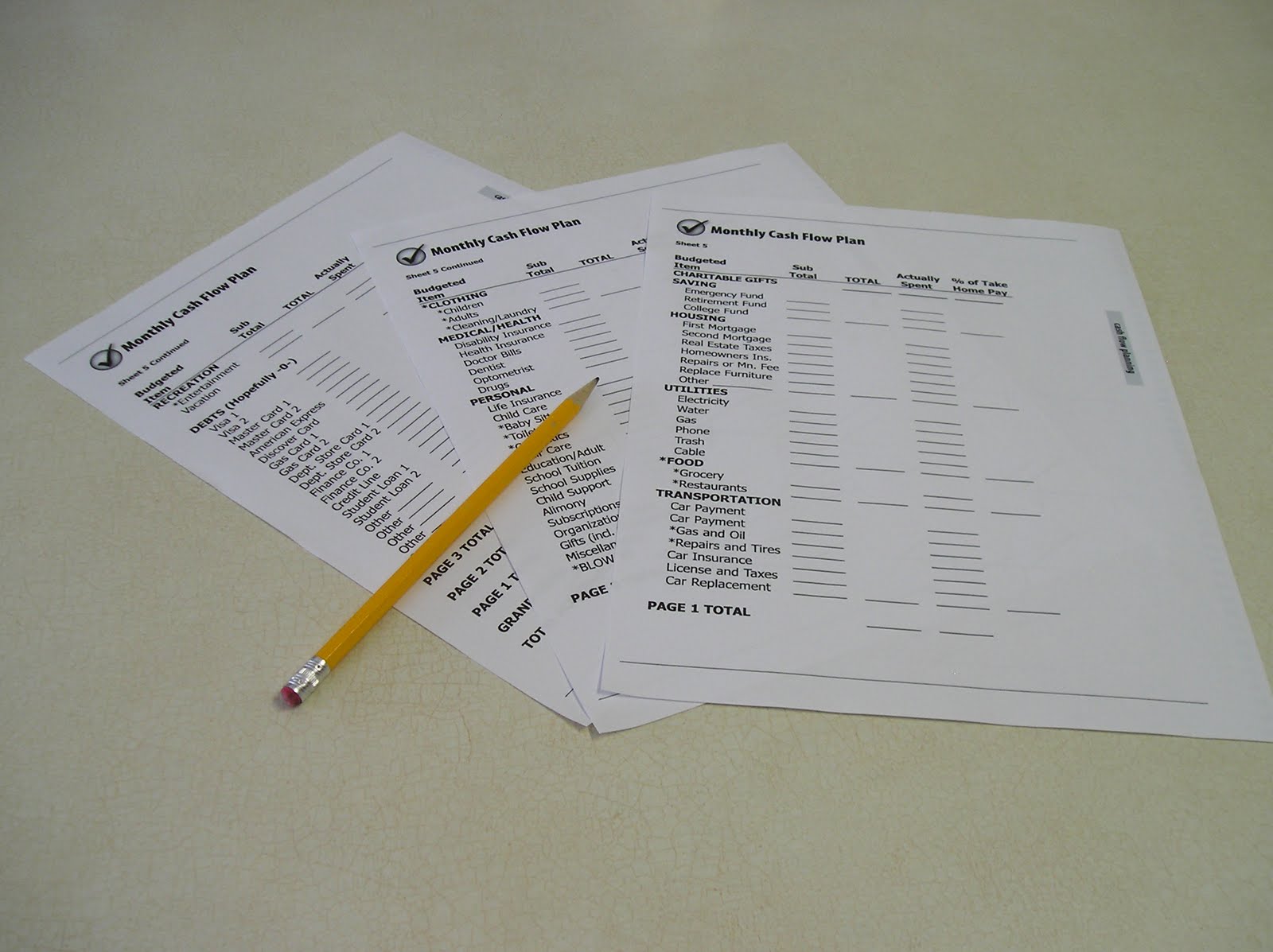
You'll also need a plan.  We use Dave Ramsey's Monthly Cash Flow Plan (find it here), so I'll be walking you through it.  If you don't want to fill it out, you can always use a legal pad.

I find it helpful to start at the end.  On the third page of the Cash Flow Plan (CFP, from now on) at the very bottom is a line in bold that reads "Total Monthly Income".  You should have figured this out in Step 1, so go ahead and fill it in.  Below that line is the word ZERO.  This is the goal.  In the budget world, balance equals Zero.

Now, back to the beginning.  Pull out the list of expenses that you made in Step 2.  Draw a line at where your income ended.  On our example sheet below (which is a simplification of our actual budget), this line comes after Caleb's Sallie Mae payment, but before mine.


Now, as much as we'd like to tell Sallie to stuff it, it is a better idea to take a look in category 4 and see if there's anything that can be cut.  Looks like we wont be saving to go to Ohio this month. :(


Voila, Ohio is gone, our math is adjusted and now we can move on to our CFP.  (See how messy things get when you use pen?)

If you're having trouble with this step because there's just too much debt, you'll want to use the pro rata plan.  Dave gives the basics here and here.  This is a more in depth look.  If you're this much underwater though, you'll want to get more help than we can offer here.

The CFP has many categories and subcategories for you to fill in.  Use your list as a guide and make any changes to the form that you might need.  You'll notice that is in basically the same order (Giving, Savings, 4 walls, etc.) as your list.  Fill in each item's cost in the Sub Total column.  At the end of each category, add up everything and put the total in the Total column.  At the end of each page, add up all your totals for the Page Total.  

If you're feeling particularly ambitious, or if addition just isn't enough to satisfy, divide the total for each category by your total income and fill in the % of Take Home Pay column on the far right.  This can be very useful if you've never budgeted before to see what areas are eating most of your income and might give you ideas for where to trim your lifestyle.

At the end of the month, you'll fill in the Actually Spent column (assuming you kept track of such things, which you should so that you can fill this in).  This will help you assess where changes need to be made so that you can make a better budget next month.  It takes a few months (3-6) to really get the hang of it.

Continue to fill in and add up categories through the whole sheet.  One nice thing about the CFP is all those categories because they'll help you think about all the things you might need to buy in a given month.  The trick to budgeting is planning ahead as much as possible.  Unexpected expenses will happen.  Use your emergency fund to cover them, then plan ahead for the next time.  Also, think a few months out.  Any big events approaching?  Birthdays and Christmas can be easier to afford if you spread the cost out.  If you save a little ($10 or $20) each month, then you wont be caught needing to pay $100 all at once.  Same goes for car repairs or household maintenance.  Establish a savings account dedicated to this, and suddenly, emergencies wont be, because you planned for them.

When you get to page three, you'll add up the totals from all three pages and compare them to the Total Household Income that you filled in earlier.  Hopefully, the Grand Total will be less.  If it isn't, you'll have to cut something.  Again, start with the Incidental categories: Recreation, Personal, perhaps Clothing and Restaurants.  If possible, don't cut these categories completely.  If you don't allow some fun in your budget, you will have fun outside of it and kill the whole thing.  

At the same time, it's important to recognize that getting out of debt means sacrificing.  This is the point where you need to tell the whiny kid inside of you to go into timeout and let the adult make tough decisions with the ultimate goal (financial peace and freedom for you and your family) always in mind.

Have things that you just can't cut, but know you should?  Or things you'd like to get eventually but aren't pressing at the moment?  Make a list.  We'll deal with them in Step 5.

If, however, your Grand Total is indeed less than your Total Household Income, this is not a license to party.  First, make sure that you've filled in everything you should have (all the categories on all 3 pages...), then it's time to do some subtraction.  Find out how much extra there is, and add that to the payment of your smallest debt.  This extra is known as a "Snowflake" and will help get your Debt Snowball rolling.  (We talked about our Debt Snowball back in May.)

Your Grand Total, minus your Total Household Income should equal ZERO.  Income = Out go.  So, add it up again and make it balance.  
Told you the eraser would come in handy.

Saturday, August 6, 2011

How to Budget : Step 2

These are the steps we take to do our budget, here we'll deal with Step 2. 
  1. Determine income and pay periods for the month
  2. Name your Income
  3. Make it balance
  4. Allocate your expenses for each week
  5. Prioritize Irregular Income


Step 2: Name Your Income


Now that you have your total income in front of you, you'll need to determine where to send it.  We recommend prioritizing your naming so that you have the basics covered.  On a calculator, or a piece of scrap paper if you're arithmetic savvy, subtract each item from your total as you go.  This will help you see how far your paycheck can go.
If you run out of money before getting to the end of the list, don't worry, go ahead and finish.  We'll deal with the overage in Step 3 and Step 5.
  1. Charitable giving - we do 10% of total income - whether to a church or a non-profit, giving a portion of your money away not only gives you a warm fuzzy feeling and makes you a better person, but it also will help you relax if money is a point of stress
  2. Savings: If your savings account/emergency fund is below $1000, try to raise it.  (If you can't fill it completely and cover #3, do as much as you can.)
  3. Four Walls: House, Food, Transportation, Clothing - this includes mortgage/rent, utilities, diapers, fresh veggies, car payment, gas, oil changes, new underwear, all insurance premiums and anything else that you need to function.  This does not include: brie, beer, spinners, another purse or that cute baby dress.
  4. Incidental expenses - includes such things as date night, trip to see grandparents, birthday gifts, a hair cut, and other things which help keep you sane, but are not truly necessary for survival.  Remember, getting out of debt is about cutting life style.  This is where your lifestyle will be cut.
  5. Outstanding debt - Make sure to pay the minimum on everything first, then add any remaining income to the debt with the smallest total balance.  Try to pay it off completely.  When you do, you can add that minimum payment to the minimum of the next smallest debt which will help you pay that one off faster.  This is the principal behind the Debt Snowball.  Don't worry about which debt has the highest interest rate, just pay things off as fast as possible so you can tell your money where to go instead of wondering where it went.
When we got to the end of this step the first few times we did our budget, it felt like we got a raise.  It's amazing how much even a little bit of money can do, when you know what it's doing and why.

We'll cover Step 3 in our next post, in which we'll determine who does get paid and who does not.

Wednesday, August 3, 2011

How to Budget : Step 1

We began posting the last time about the process of writing our monthly budget. One of the principles we work with  through our Total Money Makeover is a written budget at the beginning of every month. Like Dave says, "Every dollar has a name": which means that every penny for the month gets spent on paper before the month begins. It's not always easy, but it's incredibly rewarding; and we usually discover we have more money than we thought. When budget night comes, Caleb uses the Gazelle Budget Software on the Total Money Makeover website and Emily uses Dave's budget forms (found here).
Below are the steps we take to do our budget:  (We'll deal with the first step in this post)
  1. Determine income and pay periods for the month
  2. Name your Income
  3. Make it balance
  4. Allocate your expenses for each week
  5. Prioritize Irregular Income

Supplies:
  • previous month's paychecks and/or projected income statement
  • previous month's budget form (if it exists)
  • calculator
  • Budget forms or legal pad
  • pencil with a good eraser
  • Computer (if using online software)

Step 1: Determine Income and Pay Periods for the Whole Month

Before you can spend your hard earned cash on paper before the month begins, you have to know how much money is available to you. (For those of you with an irregular income, there's a form for that that we will discuss later.) You also need to know when you will be paid so that you can decide what bills and expenses are covered during which week in the month. Emily does the allocated spending sheet at the end of our time crunching the numbers.

We find it easiest to add up the various sources of income and write down the source at the bottom of page 3 of the Dave Ramsey form, but if you're starting from scratch, write it on the first line.

This month, our income looked like this:

School Pay Check 1 + Summer Job Pay Check 1 + School Pay Check 2 + Summer Job Pay Check 2 = Total Income


Our paychecks are currently bimonthly, but they don't come at the same time (i.e. the school pays on every other Friday, the summer job on every other Monday) -- we'll deal with that conundrum in Step 4.

Don't include any income that you aren't actually sure you will be getting.  If you work on commission, tips or hourly, budget what you can reasonably expect to receive, not what you hope you'll earn.  For example if you always work at least 20 hours a week, but can work as many as 40, budget the 20 in this step.  Following this method will help you prioritize your income and especially important if you don't have very much of it.
We'll deal with irregular income in Step 5.

Tips: Make sure you know when you can expect your pay check to be available to you, this may be different from the day you actually get paid if you have direct deposit.
Also, determine whether or not you get paid on specific days of the month, or days of the week.  Is it every other Friday or the first and third Fridays?  The first Wednesday of the month or the 1st of the month?

Next, we'll go through Step 2, in which ever dollar gets a name and life gets prioritized.

Thursday, July 28, 2011

Budgeting Again

Here we are at the end of another month.  July seemed really long this year, especially since we had our Emergency at the end of June which spilled into July.  At the lowest point, our Emergency Fund had $1.14 and our checking account had $48.  We usually have more of a cushion, but there was an issue with payroll that has since been cleared up.
Let me tell you, being that broke I was so grateful for our budget.  I looked at the bank account (gasped and swore a bit) and looked at my check book.  Within five minutes, I knew we were ok.  All our checks had cleared, and there was nothing hanging out there on the debit card waiting to clear because we use cash for all our incidental purchases (groceries, gas, clothing, etc.).  Even though we had less than I would have liked, I knew none of it would go anywhere before we got paid again.  I knew that every one of those dollars was named "sinking fund for Caleb's life insurance", which we pay at the end of the year, and would not be leaving the account.

That was our situation when we did our July budget.  Now, it's time to do August.  We have refilled our emergency fund and Caleb's life insurance fund.  Our car now has a rebuilt transmission and a new muffler.   We're free and clear to look forward to next month and all it's oncoming craziness.
Usually, we'd just adjust last month, but since August will be so completely different than previous months, we'll be starting from scratch and we'll go through it with you.
There are two forms that we use from Dave Ramsey's My Total Money Makeover site (they're in all of his books too).  The first is the Cash Flow Plan (pdf) and the second is the Allocated Spending Form (pdf).  Over the next few days we'll walk through how we do our budget so you can see how these forms work in real life.
It'll be way fun.  You're welcome.